This page contains affiliate links. We may earn a commission at no extra cost to you when you buy through them. Learn more
The Best Free Alternative to Dehancer for DaVinci Resolve
Dehancer Film is the reference for analog film emulation in DaVinci Resolve, with 60+ film stocks, 130+ camera log profiles, and physically modeled halation and grain. It also starts at $899 for a lifetime individual license. Most people searching for a free alternative to Dehancer do not need every one of its controls, they want the same photochemical look without the price. spektrafilm OFX gets closest: a free OpenFX plugin that rebuilds your image as light spectra and runs it through modeled negative, development, print, and scan stages. Below it sits next to Dehancer and two cheaper paid options, FilmConvert Nitrate and EMUL8, so you can see where the free route holds up and where it does not.
Why look for a Dehancer alternative
Dehancer earns its reputation. The film profiles are built from scans of real stock, grain reacts to exposure the way negative grain does, and native DaVinci Wide Gamut and ACES support means it drops into a color-managed project without extra nodes. Two things send people looking for an alternative. The first is price: $899 for a lifetime individual seat is well above most film emulation plugins, and the subscription adds up over time. The second is depth. The control set covering grain, halation, bloom, the CMY print head, and the LUT generator takes time to learn, and not every project needs it. If you grade occasionally, or you are building a first film look on a budget, a free tool that gets you 90 percent of the way is often the better trade.
Before you install anything: Resolve's built-in Film Look Creator
The cheapest alternative to Dehancer is the one already sitting in your Effects library. Blackmagic added the Film Look Creator to DaVinci Resolve in version 19, a single ResolveFX effect you drag onto a node with nothing to download. It gathers a stack of film controls in one panel: color presets named after film styles (Rochester, Akasaka, Elated, Vintage, Cinematic), plus halation, bloom, grain, gate weave, flicker, split tone, a vignette, and a film-gate crop for different format ratios. For a quick cinematic pass it gets a long way on its own. The core effect works in the free version of Resolve, though the deeper grain and HDR controls are reserved for Studio. The difference from spektrafilm and Dehancer is what sits under the hood. Film Look Creator is a look-development tool: its presets are sets of color primaries and stylistic curves, not emulations built from scans of real Kodak or Fujifilm stock, and there is no negative-to-print pipeline or measured density data behind them. That keeps it fast and free, and enough for a lot of projects, but it will not reproduce the response of a named stock the way a photochemical model aims to. Try it first. If the built-in look is all you need, you can stop there. When you want film color built from real stock data, that is where spektrafilm comes in.
How spektrafilm gets close to Dehancer for free
spektrafilm OFX does not remap RGB values the way a LUT does. It treats your image as a stand-in for real light, rebuilds that light as a spectrum, runs it through modeled film layers with real sensitivity and density data, develops the result as a negative, exposes it again through a modeled print stage, and scans it back to RGB. It ships 17 camera-negative stocks and 9 print stocks and papers, built from manufacturer characteristic curves and dye density measurements rather than a colorist's guess. Grain is generated inside the same density space as the development, so switching between 8mm and 70mm changes grain size the way it would on a real negative. Halation simulates red-biased scatter behind the emulsion before the image develops. A simplified spektrafilm-flow build shares the same engine for anyone who wants to build a look fast, and presets carry over to the full version. The gaps are honest ones: it is less polished and less stable than Dehancer, has no camera-specific log profiles beyond color-managed input, and the Windows build is still in beta while Linux is unsupported. For the full field of paid and free film tools, the best color grading plugins roundup compares six side by side.
If you will pay a little: FilmConvert Nitrate and EMUL8
A free plugin is not the only way to spend less than Dehancer. FilmConvert Nitrate is $129 and starts from your camera's specific color science, so the emulation is calibrated to the sensor rather than a generic input. It has 20+ stocks, a grain editor, a clean interface, and it runs on the free version of Resolve, which makes it the fastest paid path to a camera-matched film look. EMUL8 is $196 and runs as DCTLs and PowerGrades, keeping it lighter on the GPU than OFX competitors, with 15 Kodak and Fuji inspired stocks and controls for halation, bloom, and grain from 8mm to 65mm. The catch is that EMUL8 needs DaVinci Resolve Studio. Both cost real money, but both undercut Dehancer's lifetime price by a wide margin.
| Feature | spektrafilm OFX | Dehancer Film | FilmConvert Nitrate | EMUL8 |
|---|---|---|---|---|
| Price | Free | Subscription or $899 lifetime (free trial) | $129 (perpetual) | $196 (perpetual) |
| Method | Spectral simulation of the full photochemical pipeline | OFX, physically modeled from real stock scans | Camera-profiled film emulation | DCTL + PowerGrade |
| Film stocks | 17 negative + 9 print stocks/papers | 60+ stocks, 130+ camera log profiles | 20+ camera-matched stocks | 15 Kodak/Fuji-inspired stocks |
| Halation & grain | Pre-development scatter, format-scaled grain (8mm to 70mm) | Physically modeled halation and bloom, exposure-reactive grain | Simplified halation, grain editor | Modeled halation and bloom, grain 8mm to 65mm |
| Runs on DaVinci Resolve Free | Yes | Yes | Yes | No (Studio only) |
| Platforms | macOS (Windows beta) | macOS, Windows, Linux | macOS, Windows | macOS, Windows |
| Best for | Dehancer-style depth at no cost | The largest stock library and full log support | Fast camera-matched looks on a budget | Lightweight Resolve-native grading |
Stop buying plugins. Build your own.
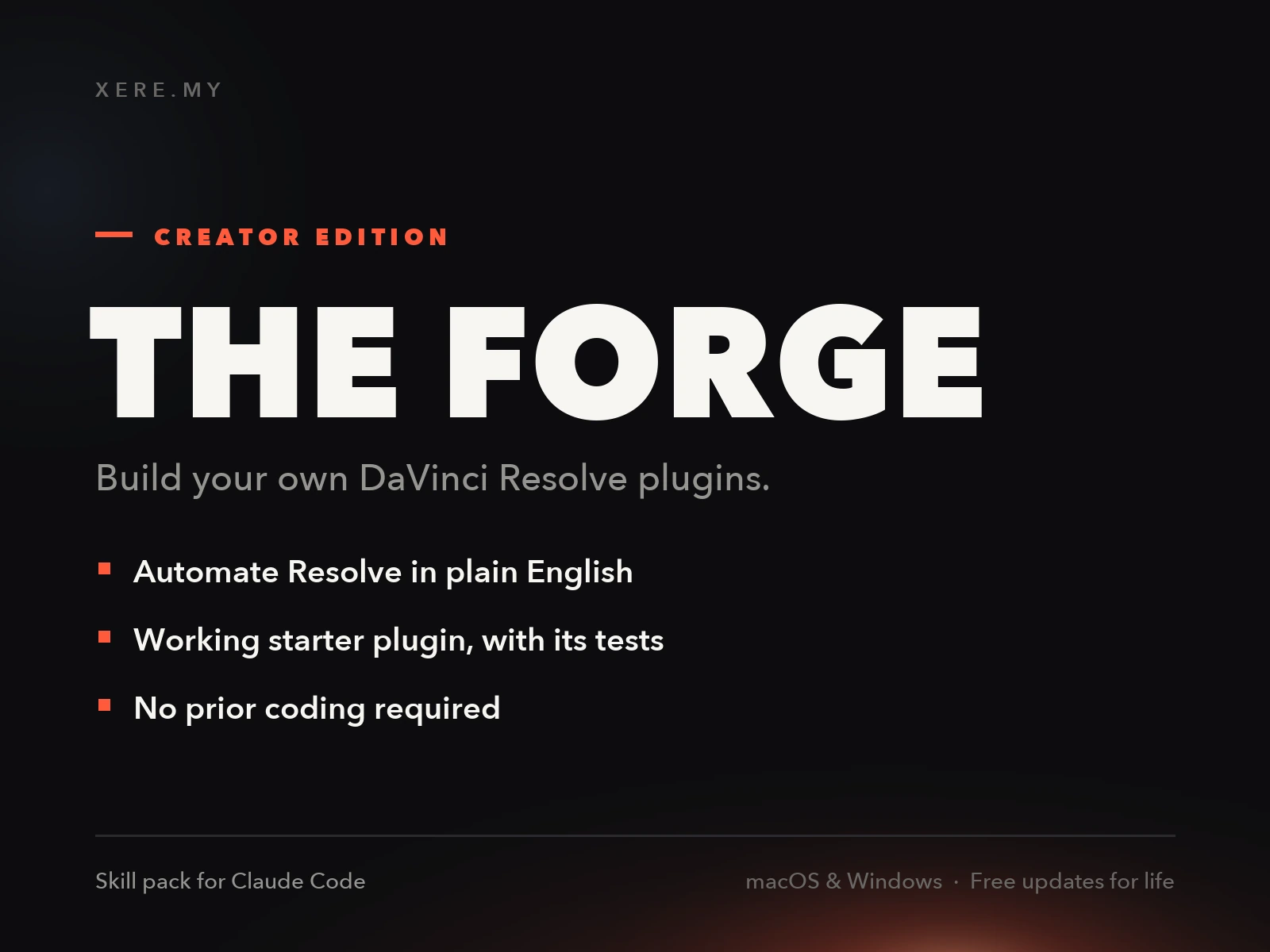
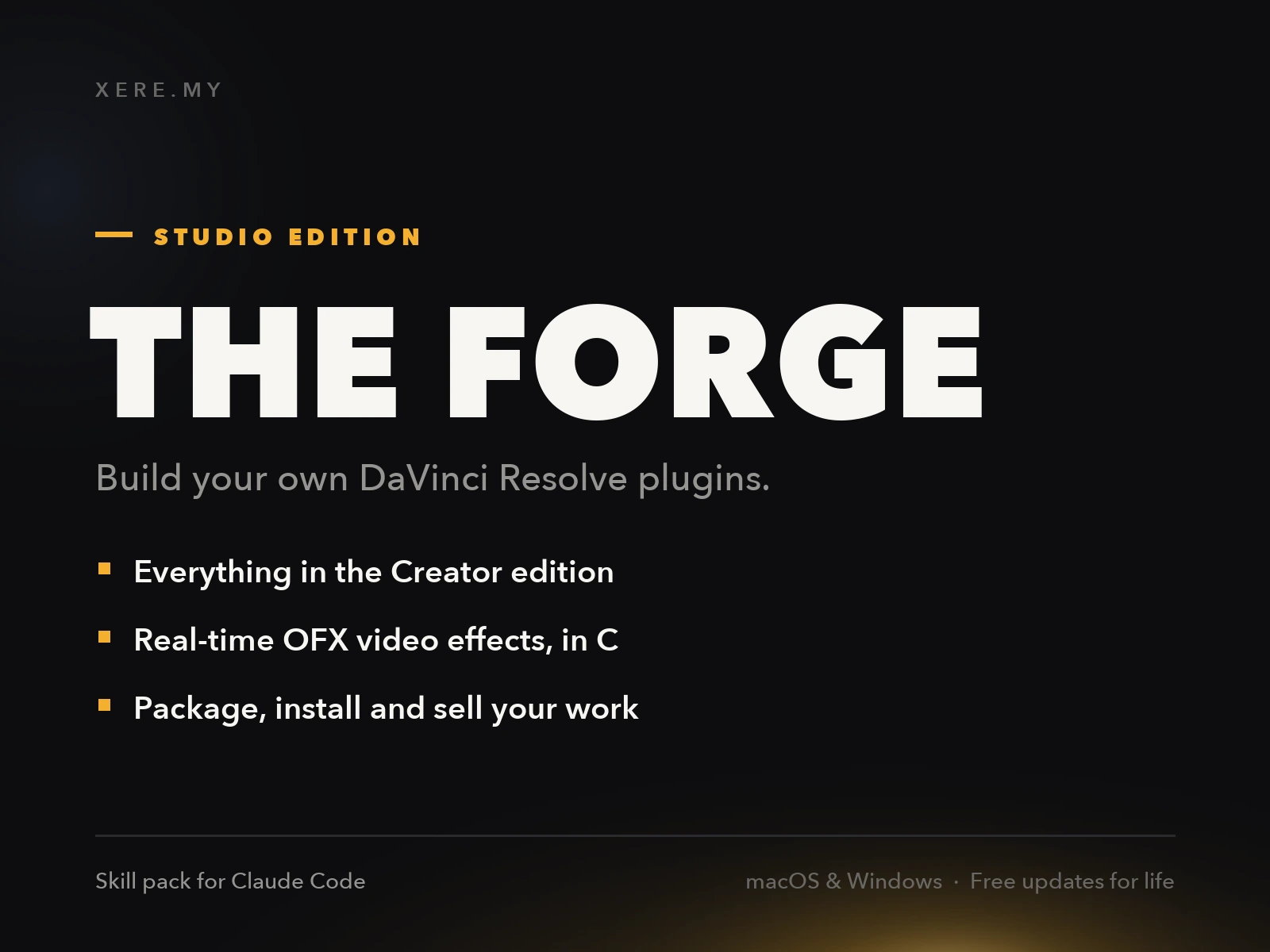
Every plugin you buy solves someone else's problem. Through The Forge skill packs, you can teach Claude Code to write, test, and install custom DaVinci Resolve tools in plain English. Save money, learn the workflow, and own your tools forever.
Verdict: the best free alternative to Dehancer
spektrafilm OFX: the free alternative to reach for Winner Best Free
The free pick, and the one that gets closest to what Dehancer does. spektrafilm runs a full spectral simulation of the photochemical pipeline instead of a lookup table: camera exposure, negative development, optical printing, and scanning, all built from real spectral sensitivity and dye density data. It ships 17 camera-negative stocks and 9 print stocks and papers, with format-scaled grain, pre-development halation, camera and print diffusion filters, and LUT export. A Process Negatives mode runs real scanned film through its print stage, closer to a virtual darkroom than a filter. It is less stable and less polished than Dehancer and has no camera-specific log profiles, and the Windows build is still in beta. For colorists willing to learn a deeper model, it is the most technically ambitious free film emulation available for Resolve, and it costs nothing.
Dehancer Film: the paid benchmark
Dehancer is what the free alternatives are measured against. It has the largest stock library here, 60+ negative and print emulations plus 130+ camera log profiles, so it normalizes Log footage before a stock is applied. Halation, bloom, and grain are physically modeled, and it supports DaVinci Wide Gamut and ACES natively. The trade-off is the $899 lifetime price and a dense control set that takes time to learn. If you grade professionally, shoot in Log, and want direct control over individual stock parameters, it is still the most complete option. If you do not, its own strengths become the reason to look for something lighter.
FilmConvert Nitrate: the cheapest paid step up Runner-up
FilmConvert Nitrate is the paid option to consider if the free route falls short. At $129 it starts from your camera's specific color science, matching the emulation to the actual sensor rather than a generic input, which is something spektrafilm does not do. It has 20+ stocks, a grain editor, and a short learning curve, and it runs on the free version of Resolve. It is the fastest way to a camera-matched film look, and it costs a fraction of Dehancer's lifetime license.
EMUL8: lightweight, but Studio only
EMUL8 runs as DCTLs and PowerGrades, which keeps it lighter on the GPU than OFX plugins and gives smooth playback with several instances stacked. It has 15 Kodak and Fuji inspired stocks with controls for halation, bloom, grain from 8mm to 65mm, chromatic aberration, and color density. At $196 it is the priciest of the paid alternatives here, and it needs DaVinci Resolve Studio, so it is only in the running if you already run Studio and want a Resolve-native grading workflow.
For a genuinely free alternative to Dehancer, spektrafilm OFX is the one to install. It runs a full spectral simulation of the photochemical pipeline with 17 negative and 9 print stocks, format-scaled grain, and pre-development halation, on the free version of Resolve, at no cost. It is less polished and less stable than Dehancer and lacks camera log profiles, so it is not a drop-in replacement for professional Log workflows, but for most creators chasing a film look it closes most of the gap. If you will spend a little, FilmConvert Nitrate at $129 adds camera-matched profiling and runs on free Resolve, while EMUL8 at $196 is the lightweight Resolve-native pick for Studio users. Dehancer itself stays the benchmark for anyone who needs the deepest control and the largest stock library, and can justify the $899 lifetime price.